The Tianshan Shengli Tunnel, the world's longest expressway tunnel, opened to the public for drive-through experience on December 26, 2025 and is set for opening on January 1, 2026, offering a much nearer road link between the southern and northern parts of northwest China's Xinjiang Uygur Autonomous Region.
Stretching 22.1 kilometers through the snow-covered Tianshan Mountains, the tunnel allows vehicles to travel across the once insurmountable geographical barrier at a maximum speed of 100 km per hour in merely 20 minutes.
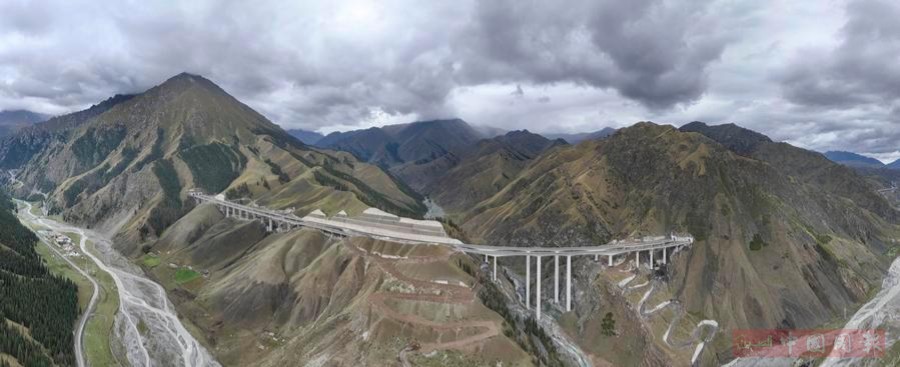
Aerial photo shows the Urumqi-Yuli Expressway under construction as it tunnels through the Tianshan Mountains in northwest China's Xinjiang Uygur Autonomous Region on August 19, 2025. (Xinhua/Hu Huhu)
The tunnel is an essential part of the Urumqi-Yuli Expressway. The opening also marked the inauguration of the new expressway between the regional capital and Korla, a vital transportation hub in southern Xinjiang. As an alternative to the existing weather-prone winding mountain roads, the expressway cuts journey time between the two important cities from about seven hours to just three and a half hours.
"This means parcels from Korla can arrive in Urumqi in half a day and in other parts of China much faster," said He Dong, head of the distribution center of J&T Express in Bayingolin Mongolian Autonomous Prefecture.
The leading Chinese courier, which has business presence in over 10 countries and regions across the world has planned cold-chain delivery services to seize the opportunities brought by shortened transportation time and sell the wide range of fresh fruit and farm produce from Bayingolin Mongolian Autonomous Prefecture to the vast domestic market across the country.
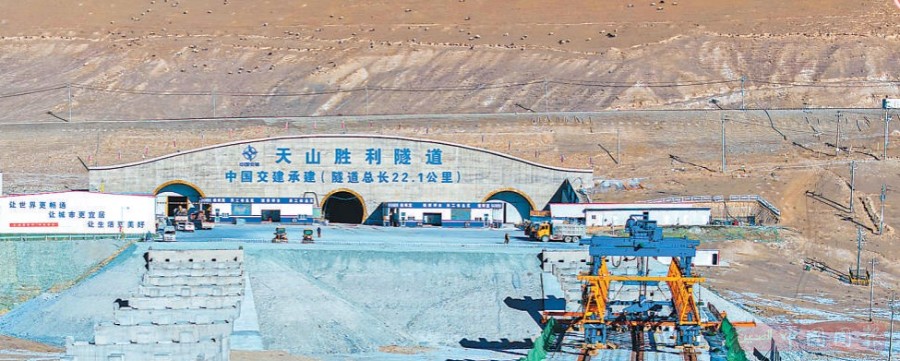
The southern exit of the Tianshan Shengli Tunnel in northwest China's Xinjiang Uygur Autonomous Region (People's Daily/Zhang Wujun)
Building a road to traverse the Tianshan Mountains has long been a dream for people in Xinjiang.
The Tianshan Mountains, measuring 2,500 kilometers in total length, constitutes the largest isolated east-west mountain range globally and the mountain range farthest from the sea. The part in China is 1,760 kilometers, accounting for more than two-thirds of the total length. The name Tianshan means "Celestial Mountains" in Chinese as ancient people were desperately daunted by such a formidable celestial-monster-like natural barrier.
In ancient times, people had to conquer frighteningly high cliffs and glacier-covered peaks to traverse the Tianshan Mountains. In 1958, Urumqi was connected with Korla via the first modern road through the natural barrier. Parallel with the Tianshan Shengli Tunnel, the road winds along the snow-capped peaks with an altitude of 3,400 meters above the sea level. The highest section reaches the 4,280-meter-high glacier-capped Shengli Pass adjacent to No. 1, No. 2 and No. 3 glaciers of the Tianshan Mountains.
Since its opening, the road has engulfed hundreds of vehicles and thousands of lives, and is thus known as "the road of death." Traffic has been prohibited on the road over recent years for glacier protection, but some still stumbled in and got stranded. Rescue was frequent.
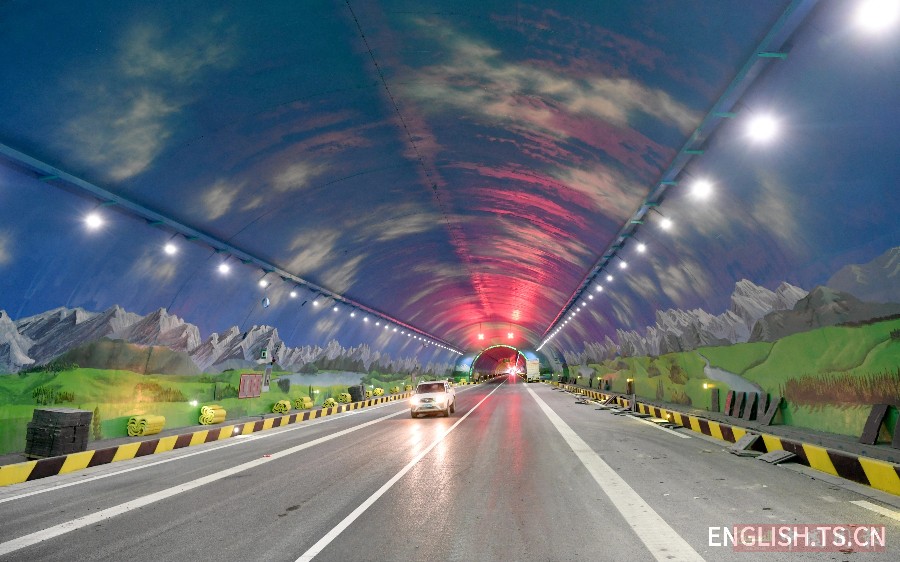
A car travels inside the Tianshan Shengli Tunnel in northwest China's Xinjiang Uygur Autonomous Region on November 13, 2025. Patterns of blue sky and clouds are painted on the tunnel ceiling to help drivers stay alert in driving. (Photo by Han Liang)
The mentioned seven-hour journey used to be the most convenient link between Urumqi and Korla. Starting from Urumqi, a driver had to make a detour in Turpan in eastern Xinjiang and traverse Tianshan Mountains via Gangou Valley in Toksun County.
Another traffic link connecting the southern and northern parts of Xinjiang is the Dushanzi-Kuqa Highway. Now a popular tourist destination, the road witnessed 168 lives devoted to its construction starting in 1974. It usually closes for as long as eight months from early October to May or June of the following year for safety reasons.
The new Dushanzi-Kuqa Expressway started construction in September 2025. An expressway project with the largest investment in Xinjiang, it is expected to be completed in 2032. Upon completion, the journey from southern Xinjiang to northern Xinjiang will be further shortened.
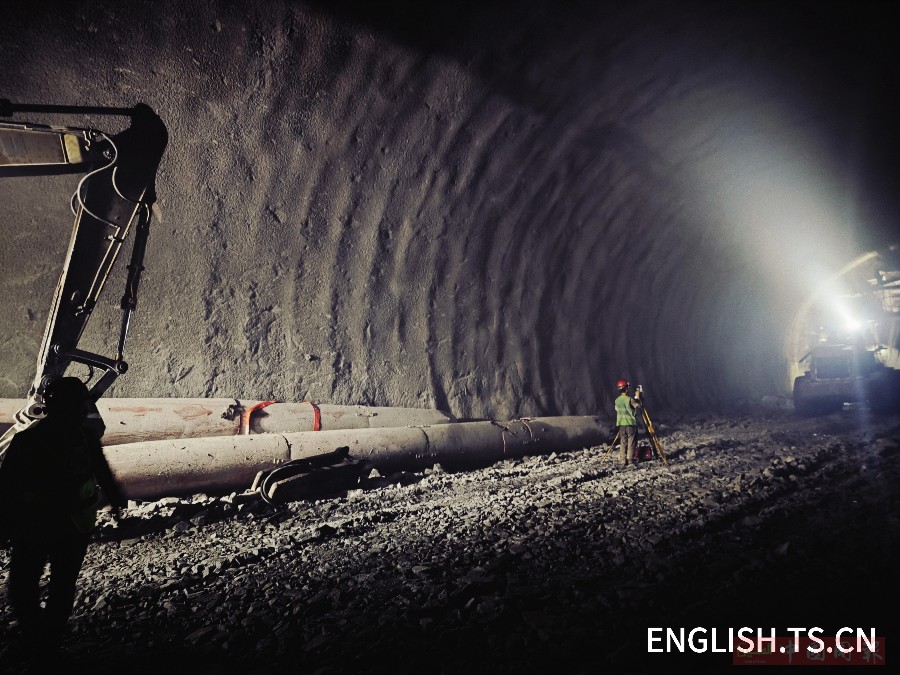
A construction worker surveys the tunnel around the entrance of the Tianshan Shengli Tunnel in northwest China's Xinjiang Uygur Autonomous Region on August 17, 2024. (Photo by Liu Xinpeng)
"The difficulties of digging a tunnel through the Tianshan Mountains are unimaginable," said Li Yalong, a manager with the construction team. He listed challenges, such as extreme cold, high altitudes, high ground stress, strong seismic activity and strict environmental requirements.
Beyond the engineering marvels, the Urumqi-Yuli Expressway, whose construction started in April 2020, is already reshaping everyday life of the people who live around.
For local herder Bata, who has been grazing his cattle and sheep on the range next to the construction site of the Tianshan Shengli Tunnel, the change has long been perceived.
In the past, selling cattle and sheep, the major source of income for Bata's family, meant long and uncertain trips to Urumqi. Weather changes, road closures, and steep mountain passes often turned a planned journey into a gamble. Sometimes, buyers waited, and so did his income.
Now, for the first time, the uncertainty is fading in Bata's heart as the travel time has been fixed. He starts to imagine travelers stopping by the beautiful pasture and drinking fresh milk tea in his warm yurt. "Tourism will grow and the cattle and sheep can be delivered to markets in Urumqi much faster and sell at a good price," Bata said with expectation.
When survey teams for the construction of the tunnel first arrived in 2017, unfamiliar with the terrain, he offered his yurt as shelter and guided engineers on horseback through valleys and over ridges, sometimes reaching sites more than 3,600 meters above sea level. Later, he joined the construction team and worked as a sanitation vehicle driver at the site.
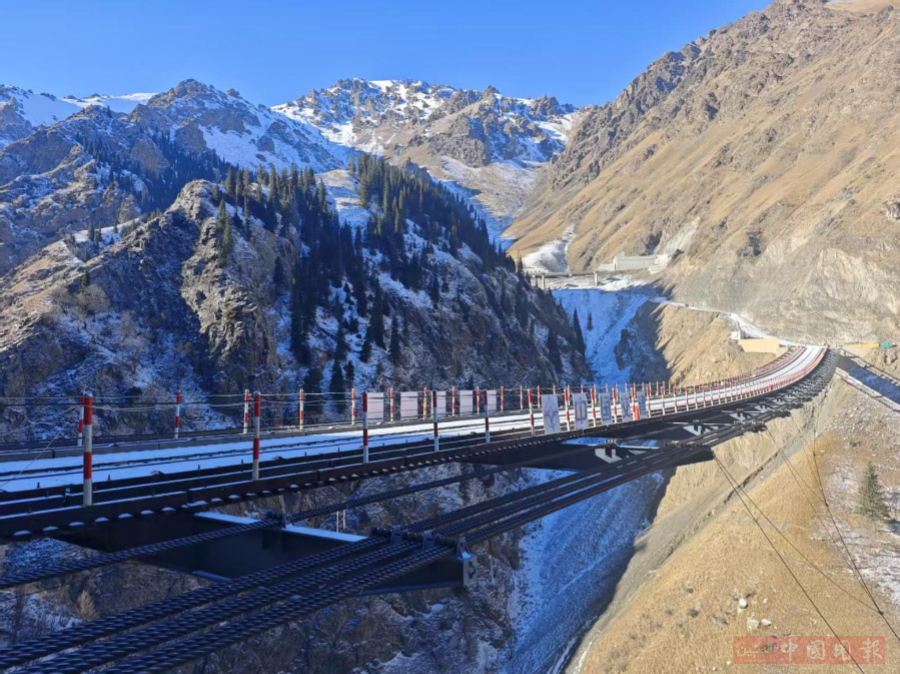
High-altitude cableway bridge on the Urumqi-Yuli Expressway (File Photo)
"Bata was always the first to arrive at work and the last to leave, and he is good at his job," said Deng Lingdong, a manager with the construction team, who witnessed the team's friendship with the herdsman.
"This land feeds us," Bata said. "Keeping it clean is part of respecting it."
That respect for the land is deeply rooted in the construction team's approach to the tunnel construction. Located near the Tianshan No.1 Glacier and high-altitude grasslands, the road project passes through one of Xinjiang's most ecologically fragile regions. The building of the tunnel itself is a decision after solid and elaborate scientific research and evaluation on local environment. The tunnel minimizes surface disturbance to the Tianshan Mountains and is the optimal approach available to preserving the fragile ecosystems, according to Deng.
Protecting water resources was a top priority in the construction. All construction wastewater has been treated to meet national surface water standards and fully reused for production, equipment cooling, dust suppression, and vegetation restoration, said Deng.
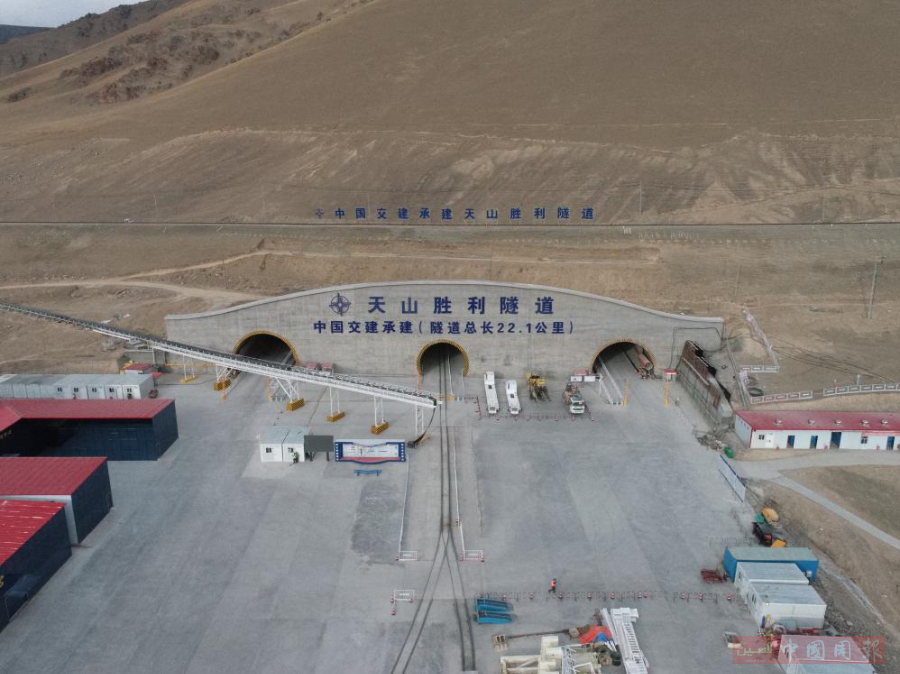
Aerial photo shows the exit of the Tianshan Shengli Tunnel. (Photo by Deng Lingdong)
To cross the Urumqi River during construction, builders erected a high-altitude cable bridge instead of a conventional access road. Though several times more expensive, the structure avoided direct disturbance to the riverbed and surrounding grassland. "It costs more, but is a good deal considering the environment," said Deng.
Source :Tianshannet | By Zhang Shijie, Lan Zheng and Cheng Li