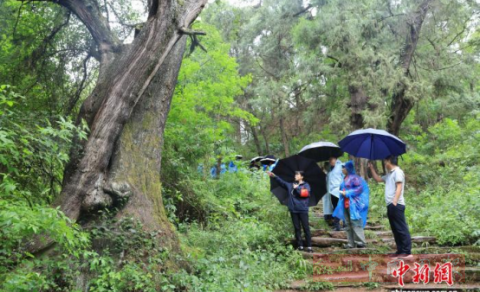
GUANGYUAN, Sichuan, June 7 (China News Service) — “The Ancient Shu Roads lead not only through mountain passes and rugged terrain, but also to the lights of villages and towns.” said Fuhui Xie, senior reporter with the Nordic Chinese Newspaper in Sweden, duting a visit to Tianxiong Village in Guangyuan’s Zhaohua District on June 7. Nestled beneath Tianxiong Pass along the Ancient Shu Roads, Tianxiong Village lies about two kilometers from Zhaohua Ancient City. Backed by the historic route and surrounded by pastoral landscapes, the village embodied both the rich cultural heritage of the Shu Roads and the vitality of rural revitalization.
Participants in the “2026 Overseas Chinese Media Tour of Sichuan and Chongqing — Focusing on the Chengdu-Chongqing Twin-City Economic Circle” followed the historical trail of the Ancient Shu Roads into Zhaohua District.Xie expressed particular interest in Tianxiong Village’s transformation.
“Rural areas have changed tremendously,” she said. “In the past, when people thought of villages, they imagined loess-covered farmhouses. What I see today are boutique homestays, fruit and vegetable farms, and craft workshops. The transformation is remarkable. More importantly, local residents can support themselves through jobs created within the village, while the village itself continues to prosper. It’s a virtuous cycle.”
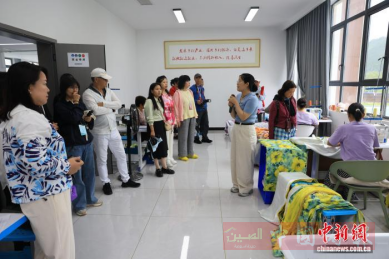
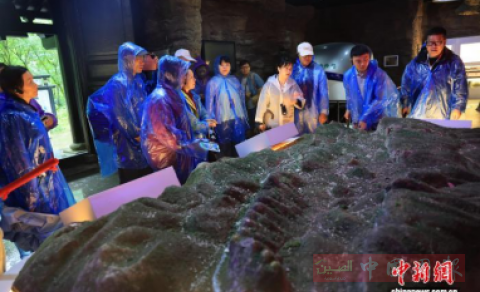
On June 7, representatives of overseas Chinese-language media visit a handicraft workshop in Tianxiong Village during the 2026 Overseas Chinese Media Tour of Sichuan and Chongqing. Photo by Zhang Lang.
If Jianmen Pass helps visitors understand the perilous nature of the Ancient Shu Roads, and the Cuiyun Corridor showcases their lush greenery, then Tianxiong Village reveals their vitality and living legacy. The ancient route is no longer merely a historical transportation corridor; it has become an important link connecting rural tourism, the resources of the ancient city, and the region’s growing cultural tourism economy.
According to JuxianLi, Party secretary of Tianxiong Village, visitors to Zhaohua once tended to leave after touring the ancient city. Today, the village hopes to encourage them to stay longer.“We want visitors to explore the countryside after visiting the ancient city, pick fresh produce, and spend a night in a homestay,” Li said.
To achieve this goal, Tianxiong Village has renovated the facades of 458 rural homes with themes inspired by the Three Kingdoms culture, while building and upgrading five homestays. Drawing on local specialty industries such as grapes, strawberries, and dragon fruit, the village has also developed fruit-picking experiences, agricultural study programs, and countryside sightseeing activities.
“We’re not simply repainting houses or paving roads,” Li said. “We want visitors to have things to see and do, so they will choose to stay.”The village has also adopted rural operation and homestay management practices from eastern China’s Zhejiang Province, launching integrated tourism products such as “Ancient City Night Tours and Morning Farming Experiences” and “Agricultural Activities and Handicraft Workshops.” These efforts aim to convert tourist traffic generated by Zhaohua Ancient City into longer stays and greater economic benefits for Tianxiong Village.
Standing atop the gate tower of Zhaohua Ancient City, XineZhu, associate publisher of China Weekly in Egypt, looked out over the city’s historic streets, where stone-paved lanes, ancient gates, traditional alleyways, and relics of the Three Kingdoms period intertwine.“In the distance are mountains, and beneath my feet are centuries-old stone roads,” Zhu said. “The scenery may have remained unchanged for hundreds or even thousands of years. It feels as if people are walking through history itself.”
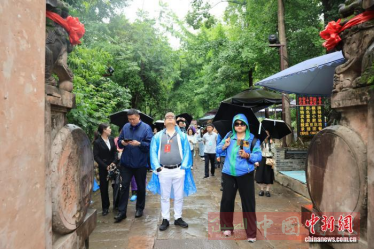
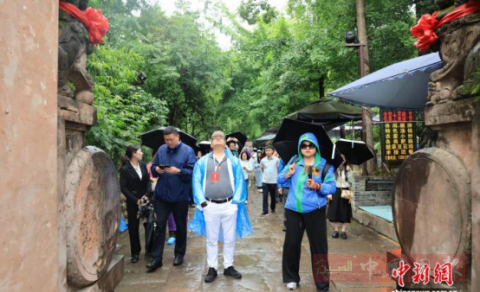
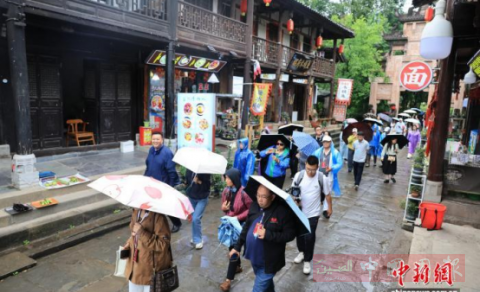
On June 7, overseas Chinese-language media representatives tour Zhaohua Ancient City during the 2026 Overseas Chinese Media Tour of Sichuan and Chongqing. Photo by Zhang Lang.
Known as Jiameng in ancient times, Zhaohua Ancient City was first established during the Spring and Autumn and Warring States periods. It boasts more than 4,000 years of history and over 2,300 years of continuous county administration. Surrounded by mountains on all sides and bordered by water on three, it has earned titles such as “The First County of Bashu” and “The Second Capital of Shu.” It is also one of China's best-preserved ancient cities associated with the Three Kingdoms era.
XiaohuaXu, a guide at Zhaohua Ancient City, noted that younger visitors increasingly value immersive experiences.“To help visitors engage more deeply with the city’s history, we have introduced NPC role-playing activities and immersive theatrical performances,” Xu said.
“The architecture reflects the distinctive character of Bashu culture and carries a profound sense of history,” Xie said. “At the same time, the city is full of everyday life, with people constantly coming and going. Watching the sunset over the ancient city while catching the aroma of home-cooked meals drifting from nearby houses creates a unique scene where history and daily life come together. It’s something more international visitors deserve to experience.”