GUANGYUAN, China, June 9 (China News Service) — “The sense of familiarity came back instantly.”Walking through the Third Front Memory Block in Lizhou District of Guangyuan, Sichuan Province, Yao Weimin, a correspondent for the Netherlands-based Chinese-language newspaper China-Netherlands Business Post and a former factory worker with 12 years of industrial experience, pointed to a milling machine and said, “I've operated this type of machine before. You have to pull out this handle before the cutting tool will move. This is a universal milling machine capable of processing various surfaces.”
Yao lingered in front of the old production equipment displayed in the block, his thoughts returning to the fervent years of China's Third Front Construction. As he skillfully explained the functions of one machine after another, he became visibly emotional, his eyes reddening slightly as he left the workshop.
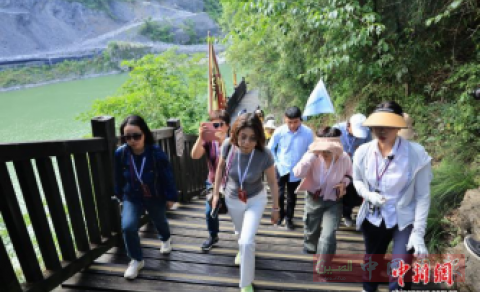
On the same day, representatives of overseas Chinese-language media participating in the “2026 Overseas Chinese Media Tour of Sichuan and Chongqing — Focusing on the Chengdu-Chongqing Twin-City Economic Circle”, visited Lizhou District in Guangyuan. Old walls and vintage industrial artifacts in the Third Front Memory Block transported the visitors back to the production scenes of the Third Front Construction era.
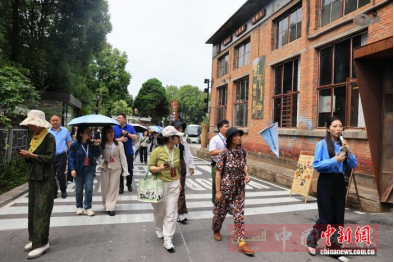
Representatives of overseas Chinese-language media participating in the 2026 Overseas Chinese-Language Media Sichuan-Chongqing Tour, themed on the development of the Chengdu-Chongqing Twin-City Economic Circle, visit the Third Front Memory Block in Lizhou District, Guangyuan City, Sichuan Province, on June 8. Photo by Zhang Lang
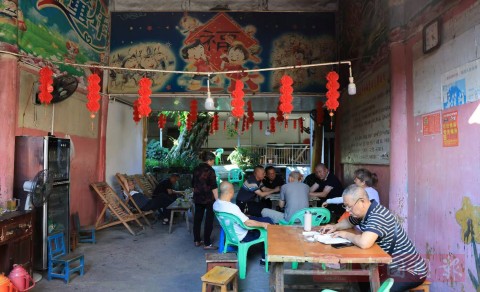
Located in Guibei Community of Dongba Subdistrict, Lizhou District, the Third Front Memory Block forms part of a red tourism route linking southwestern China and the Chengdu-Chongqing region. It is a cultural tourism destination integrating sightseeing, educational programs and cultural experiences.
According to Cui Rong, deputy director of the Lizhou District Cultural, Tourism and Wellness Industry Development Center, the block takes “memory” as its soul and “experience” as its core. Through exhibition areas, themed streets, factory wall murals and interactive installations, it systematically showcases the history of Third Front Construction in Guangyuan while faithfully recreating the production and daily life scenes of the period.
Wang Weiping, editor-in-chief of Italy's Overseas Chinese Network, said he became a factory worker immediately after graduating from school and has always maintained a deep affection for industrial production.“Back then, we used these very machines to manufacture parts. Those individual components could then be assembled into automobiles and other large products,” Wang said.
He added that when he first arrived in Europe, he admired the advanced technologies and craftsmanship there. Today, China's industrial capabilities have grown increasingly strong, giving him a profound sense of confidence and pride.
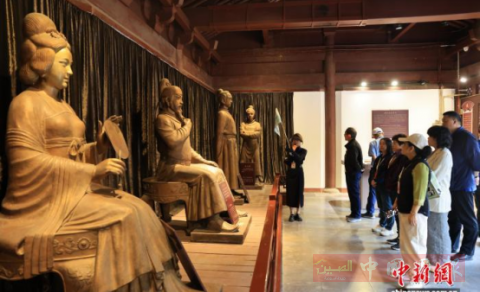
Along the banks of the Jialing River stands Huangze Temple, a shrine dedicated to Wu Zetian, the only female emperor in Chinese history. The temple is one of the most important cultural symbols of Guangyuan, known as the “hometown of the Empress.”According to public records, Huangze Temple was first built during the late Northern Wei Dynasty more than 1,500 years ago. After Wu Zetian ascended the throne, she ordered her portrait to be enshrined there. The temple's name, Huangze, conveys the meaning that the emperor's benevolence extends to her hometown.
As China's only female emperor, Wu Zetian possesses strong international recognition. The historical setting, cultural relics and narratives preserved at Huangze Temple have transformed the concept of the “hometown of the Empress” from a city label into a significant cultural landmark.“People in Africa are very interested in Chinese culture,” said Wang Shuhua, vice president of Nigeria's West Africa United Business News. “Wu Zetian, as the only female emperor in Chinese history, has tremendous value for cultural exchange and communication.”
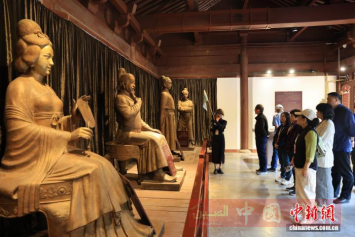
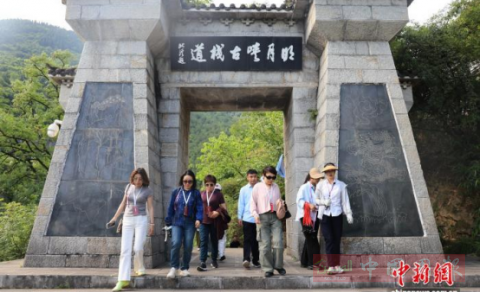
Representatives of overseas Chinese-language media participating in the 2026 Overseas Chinese-Language Media Sichuan-Chongqing Tour, themed on the development of the Chengdu-Chongqing Twin-City Economic Circle, visit Huangze Temple in Lizhou District, Guangyuan City, Sichuan Province, on June 8. Photo by Zhang Lang
From the Third Front Memory Block to Huangze Temple, overseas Chinese-language media representatives witnessed the multiple cultural dimensions of Guangyuan's landmarks in Lizhou District.
Cai Youming, editor-in-chief of the Philippines' Commercial News, said the diverse cultural resources he encountered during the visit collectively shaped the unique identity of Lizhou District and provided overseas audiences with multiple perspectives through which to understand Guangyuan.
“From history and culture to tourism and industry, Guangyuan is a diverse city," Cai said. "More people should get to know Guangyuan and come to experience it for themselves.”